Showing posts with label Capitalism. Show all posts

Tuesday, March 1, 2016

Drowned Out

"...but my silence is real. If I hid it from you, you would find it again a little farther on." -Maurice Blanchot

Noise music presents a bit of a quagmire for critics, because ascertaining its success or failure is both foolish and impossible- how would someone “succeed” or “fail” to make an album of noise? To get around this, criticism can appeal to the subcultures of noise-noise rock, harsh noise, strains of industrial music- making sense of the noise through its coarseness, how much it rocks, or how industriously it thuds along; it can can also say what the noise sounds like (if you like kung-fu punching sound effects, you’ll love this noise!). The presence of noise can represent unwelcome disorientation, as it seems to on The Jesus and Mary Chain’s “Psychocandy”, where pop hooks are undermined by shrieking feedback. But thinking or writing about unqualified noise itself seems too difficult- how could one’s opinions about noise be anything but totally subjective?


Maybe this subjective relation to noise could be overcome through political solidarity. Noise seems to gain political import when it works as a cultural revelation, as a sonic barrage through which the buzzing urgencies of consumer capitalism or the routinized horrors of war can be tenuously discerned. Music offers an aesthetic experience, “noise” simulates the experience of obliteration. Attempting to make listening to noise into an aesthetic experience involves attempting to make obliteration into a lived event- or attempting to reduce impersonal capitalism to personal experience. In a 2009 interview, the British philosopher Ray Brassier speaks on this issue, saying


“The suggestion that capitalism is somehow ‘like’ noise could easily be construed as some sort of dubiously Romantic aestheticization: capitalism as sublime, unintelligible phenomenon, etc...”


Merzbow (Photo via The Quietus)
So, politicizing noise in this way ends up being the ultimate in banality- noise being a product of capitalism that dubiously claims to encapsulate the violence inherent in its production. Rather than conceiving of noise as a reactionary non-genre, a rejection of genre identification, Brassier argues that noise ought be thought of as the obsolescence of genre- the impossibility of identification. Brassier cites the band To Live and Shave in L.A. as exemplifying this tendency. Their music consists of a melange of genres that are combined in a way that sounds akin to a malfunctioning synth artlessly generating new timbres- Brassier writes, “…each song indexes a sound-world whose density defies abbreviation.” This density precludes subcultural identification (noise pop, harsh noise etc.), there is too much information to process and therefore no normative aesthetic experience to be had. In a 1999 interview the Japanese noise-maker Merzbow echoes this disinterest in cultural identity, saying “Sometimes, I would like to kill the much too noisy Japanese by my own Noise. The effects of Japanese culture are too much noise everywhere. I want to make silence by my Noise.” Adhering to Brassier’s stipulation that noise isn’t analogous to capitalism, Merzbow’s Noise is a response to the cultural noise that surrounds him- not an attack on culture on behalf of alienated listeners, but a gesture towards the extinction of listening; it is inspired by a speculative post-apocalyptic silence. After every listener has been annihilated, all that will be left is Noise.

Wednesday, October 8, 2014

...But Who's Counting?: DJ Spooky's Aesthetic Imagination

"Things are always happening. It seems wherever I go there is drama. People are like lice, they get under your skin and bury themselves there. You scratch and scratch until the blood comes, but you cannot get permanently deloused ... I want the whole world to be out of whack, I want everyone to scratch himself to death. "- Henry Miller

"I'll do a mix to highlight different styles of scratching ... I have works from John Cage, Joseph Beuys, different mechanical pianos, Ornette Coleman, Miles Davis ... you'll hear them all mixed and collaged. It's always interaction- human gesture, movement, inscription ... "- DJ Spooky from the lecture "Turntablism as Performance Art "


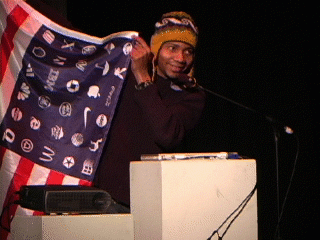
Paul Miller, AKA DJ Spooky That Subliminal Kid, is an electronic musician and academic. I became interested in him partially because of how integrated his artistic and critical practices are: his critical writing clarifies his music and vice versa. This may be because he refined his DJing while studying critical theory at Bowdoin College, and it reflects the fact that one activity of the DJ-sampling- brings paradoxes surrounding authorship to the fore. DJ Spooky, I think, is indebted to both turntablism's roots in John Cage's project of rigorous banality (Imaginary Landscape no. 1) and to hip-hop sampling. In fact, his work suggests their overlap and ultimate indistinction.

Sampling problematizes authorship. When MF Doom constructs a beat by looping a snippet of a Steely Dan song, he uncovers expressive potentialities within the sample that were not present in its original context. When an element of a song is shown to be loop-able, reproducible, it's functionality and tonality change. DJ Spooky borrows John Cage's notion of sound as information. In the essay "Loops of Perception" , he clarifies this somewhat austere notion by quoting Don Delillo's "Cosmopolis": "In fact data itself [is] soulful and glowing, a dynamic aspect of the life process." In another novel, "Underworld," Delillo writes, "Capital burns off the nuance in a culture ... Not that people want the same things, necessarily, but that they want the same range of choices ." The sample, in DJ Spooky's hands, reduces a piece of music to a form of information that can be endlessly manipulated- "customized" - by capitalist subjectivity. What room is there for authorship in this paradigm, where a song is basically fodder for remixing?

One of DJ Spooky's better known projects is "Rebirth of a Nation," a cinematic remix of DW Griffith's 1915 silent film "The Birth of a Nation". The film portrays the antebellum south, where actors in blackface wreak havoc and are ultimately subdued by the heroic Ku Klux Klan. The film was revolutionary in terms of technique- the film is a technical masterpiece and an indispensable part of the medium's history. "The Birth of a Nation" was made ​​possible by technological advances brought` about by the accumulation of capital. The film itself, a supposed recounting of history, effected the real world it was supposedly independent from: after it's release, there was a resurgence of Ku Klux Klan activity, the film acting as a recruitment tool. Techniques of reproduction - or converting lived experience to information- the proliferation of which is intrinsic to the growth of capital, creates necessarily this sort of hyperreal echolalia that defines modern western existence.  By applying DJing techniques to the film, turning portions of the film into manipulable samples, DJ Spooky highlights their contingency. Above I asked "What room is there for authorship in this paradigm?". Rather than reinforcing the rigidity of the information age, the author (in this case, the DJ)'s artistic decisions obviate the fact that, to quote Foucault, "[things], in their substance, can change."  Authorship as provocation. For DJ Spooky, who sees a world turned into information as his palette, a sample can reflect an unnerving paradigmatic contingency (for instance in his project sampling and mixing auditory, visual and statistical information regarding climate change's effects on Antarctic ice, information that documents the total instability of our mode of life), the play of sampled information emanating from DJ Spooky's turntables and projectors suggests the randomness of all information, creating an effect in the private mind of the listener that is akin to the shattering of a wineglass when a soprano belts a high C.

On the track Asphalt (Tome II)  off of his record "Optometry", DJ Spooky and jazz pianist Matthew Shipp provide a stammering background for Carl Hancock Rux's smooth spoken word delivery. Rux delivers an oblique narrative about the dissolution of solidarity and artistic integrity in the hip-hop scene. The recurring phrase throughout the song is "I like it." After describing the disintegration of a scene, Rux's wry announcement of "Yeah, I like it" is sampled and repeated, becoming part of Spooky's mix. This implies, ultimately, that the eternally "current" coolness of hip-hop is indistinguishable from the vigilant boredom of Cage (see 4:33 ). By fostering an aesthetic that pursues the indistinction between the ultra-cool, live-streamed present and nowhere, DJ Spooky reminds us that, in his words, "another world is possible".

Monday, August 19, 2013

The Empty Tourist: Lost In Translation and Narrative Alienation


In Obama's Dreams From My Father, he wrote:
To avoid being mistaken for a sellout, I chose my friends carefully. The more politically active black students. The foreign students. The Chicanos. The Marxist Professors and the structural feminists and punk-rock performance poets.We smoked cigarettes and wore leather jackets.At night,in the dorms, we discussed neocolonialism, Frantz Fanon, Eurocentrism, and patriarchy.When we ground out our cigarettes in the hallway carpet or set our stereos so loud that the walls began to shake, we were resisting bourgeois society's stifling constraints. We weren't indifferent or careless or insecure. We were alienated.
This paragraph, undoubtedly written with a wry and knowing smile, encapsulates a common liberal vision of subculture. If you are rebelling against the "system", it's because you're having troubles dealing with your own problems. These problems may be serious or (more likely) superfluous, but being outside of the mainstream is more about what you are ("expressively") as an individual than any sort of larger statement about the conditions that gave rise to what you are.  Ironically, a famous populist radical put this idea best: "Maybe there ain't no sin and there ain't no virtue, they's just what people does. Some things folks do is nice and some ain't so nice, and that's all any man's got a right to say."

This sort of folksy, sighing rhetoric is pleasant enough as a sort of humanist palliative, the kind of thing that lets us put the book down and go back to our lives, but it buys comforting cliche at the cost of detail. Moreover, the sentiment itself isn't universal. It's born of a certain set of very modern values.


In Lost in Translation we meet two characters, a recent college graduate named Charlotte and a washed-up actor named Bob, adrift in a foreign land. They're both worried about the same things in different ways;  about their respective marriages (new and old), kids, and the deep, hollow aimlessness that they feel stuck in with no agenda in Japan.  Rather than coming off insightful or wise, this feels like a performance of intimacy,  even set against the intended background of "phony" performances that Bob executes with a grimace as a part of his advertising and PR work.  Down underneath the shifting structure of our social duties, Bob and Charlotte tell us, we're all the same kids at the core.  We have common fears, common hopes, and our own little quirks. We're supposed to the see the parallel; two points of the "cycles of life" that come close to one another in the null environment of Tokyo, uniting two people that would otherwise remain strangers to one another. 


This is a compelling line and it's delivered beautifully, but the environment that Bob and Charlotte find themselves in and how they react to it says far more about them than any of their intimate, confessional scenes.  Much of the film depicts Charlotte and Bob wandering in the vast confines of Tokyo. Presumably Tokyo was picked because it is an eminently modern city; despite Charlotte's foray into a Buddhist temple (she feels nothing after) much of the scenery could fit in somewhere between Midtown and Vegas.  For a majority of the movie they could be in any city they don't understand.  Just as we have common fears, hopes, and our own little quirks, the most modern parts of our mega-cities share a cosmopolitan sameness flavored with individual kitschy touches of history.  This is supposed to be a sort of calming realization; a city is just a city just as a person is just a person. It's our common human construction, going back to the dawn of civilization. And, in the hands of Bob and Charlotte, both aimless and both having no apparent monetary concerns, the city becomes a playground.  


Debord wrote in Society of the Spectacle that capitalism was a coagulation.  Like Adorno before him, Debord thought that the specific historical nature of human reason in each period had its own dynamics that worked dialectically.  More specifically, he believed that this dialectical process was slowed by capitalism to the point of arrest.  He thought that our culture was a continual excretion of this arrested process; the modern explosion of fractured narratives was a sort of distorted snapshot of the real material conditions that were the stalled engine of historical progress.  This image of abstract individuals fed back into the dialectical material conditions that were its original basis and continued to slow them down.  Things and people were caught up in a narrative feedback loop that kept them from moving forward.  And the monolithic capitalist city was a physical manifestation of this vicious cycle. 


Though  Lost In Translation doesn't make claims that are this bold or pessimistic, it does recognize that the situation of being a tourist in a large city is a very special one. When you visit Tokyo or New York City or London without an agenda, it turns into a sort of theme park.  All of the compaction that is part and parcel of individual lives in the cramped confines of a city becomes unreal and difficult to penetrate when we don't have a structured interest in the specific details of it.  This is because the public space of a city is excessive, abstract, and impersonal. People who live in it successfully know how to draw off what they need from the excess of things that it offers while maintaining their internal agenda. The unstructured tourist, on the other hand, sees the day-to-day activities of the city for what they are; in the crowds of people they don't know, they see the bare, depersonalized flow of desires and needs that undergirds human individuality.  This can give us insight into what makes a place a tourist attraction; in the faceless slush of the day to day life of the city the most successful activities and locations manage to bring in the most tourists because they have some sort of grounding individuality.  This individuality is commonly historical (Ellis Island), prestigious (Carnegie Hall) and/or extreme (The Empire State Building).


Analogous narratives of individuality and its accompanying security attract Charlotte and Bob to their common stories.  Their stories (marriage, children, career) function like tourist attractions; these historically meaningful narratives provide them with bulwarks against the ego-annihilating buzz of Tokyo.  However, their invocation of these stories to protect themselves also brings into stark relief their failure to measure up to the stories' abstract standards.  Their ennui simultaneously protects them from the harsh alien environment and makes them into self-involved and unaware tourists.  However, we shouldn't think that this failure is some sort of radical deviance from the way these narratives are supposed to work; Charlotte and Bob are exactly what these stories are supposed to produce.  In response to the inhuman whir of Tokyo, they have achieved the modern dream of individuality and self-sufficiency, which is exactly the dream of the isolated, unchanging observer.  The reason that Bob and Charlotte can share their uniform and childlike hopes and dreams is not because they both have a lot in the common human condition, but because they've come through these stories to the same place; they both manage to maintain an identity by constantly failing in comparison to something that will never change. With only the abstract conflict and structure of narratives to limit them, they float free from everything else, wading around in the bewildering, austere, and meaningless beauty that comes with being a tourist. 


The worry is that in the modern situation, we all want to be tourists. And we're going to get what we want.

Thursday, July 11, 2013

Our Father, Who Art Irrelevant: The Pitiful Political Tragedy of Yeezus

With the first notes of Yeezus, Kanye West's production team makes sure you know you're not listening to My Beautiful Dark Twisted Fantasy.

A quick wikipedia search brings up this quote from The Guardian: "With this album, we ain't drop no single to radio. We ain't got no NBA campaign, nothing like that. Shit, we ain't even got no cover. We just made some real music."

This is the central gesture of Yeezus. Kanye fits into a common pattern of mind-boggling success; after ascendance, divergence.  When Cobain saw what he and his friends had wrought with Nevermind, he crafted In Utero in order to try and shake it off.  This is a simplistic interpretation of that record, and a correspondingly fairly childish interpretation of his reaction to fame.  But in its simplicity, and in its childishness, it's a proper analog to Kanye West's move on Yeezus.

After, Kanye assures us with the quote above, he's moved beyond all of the unthinking duplicity of the "mainstream".  When he says "Fuck y'all corporations/ you can't control me" and "Move my family out the country so you can't see where I stay" he sounds about as rebellious as your wealthy, tax-evading uncle when he's had a few too many drinks. The idea that a record released on Def Jam that leaps up to #1 on the charts could in any way be subversive demonstrates what can only be called stupidity.  On The College Dropout, Kanye's political interests sounded intimate and coarsened with a good-humored experience.  What little that does sound interesting on this song comes in the first verse.  This sort of could fit in right alongside the sentiments of his earlier work; for example, "That's that broke nigga racism/That's that don't touch anything in the store/That's that rich nigga racism/Come in, please buy more" could fit perfectly right next to "They take me to the back and pat me/ Askin' me about some khakis/But let some black people walk in/I bet they show off their token blackie." Compared to confrontational honesty of this personal narrative of racism, the inane rhetoric of the second verse sounds even more delirious and paranoid.


West has clearly not taken Drake's latest axiom to heart on this record; The G.O.O.D. Music clique is conspicuously absent on Yeezus, an album replete with new friends.  Pusha T has no verse on this record. Nor does Big Sean. Kid Cudi's bland vocals could have been performed by anyone.  And the rappers that are included are Chicago locals that have little recognition or appeal outside of the city.  This is a piece in Kanye's "rebellious" puzzle; he has rejected the universalist approach of corporate radio and replaced it with a "defiant" provincialism.  This move, like so many of the human gestures on Yeezus, falls flat on its face.  The performances of King L and Chief Keef, while still incongruent, manage enough of a cold, estranged affect that they make Kanye's earnest vitriol sound even more out of place than it already did.

 The production team on Yeezus is staffed by a caste of current indie darlings, including trap hero Hudson Mohawke, Daft Punk (who we've dealt with elsewhere), and Evian Christ from the experimental label Tri Angle. Among them is Justin Vernon, one of a few stalwarts from MBDTF.  When Vernon talks about Kanye in interviews he's depressingly laudatory, sounding more like an excited frat boy than the same man who demonstrated the lyrical sensitivity of the careful and intimate Bon Iver records.

Despite all my venom for Kanye's presence on his own record, I think that the musical environment of Yeezus is truly beautiful and startlingly composed.  From the simplest and least daring choices on the record to the most thunderous noise arpeggio, Yeezus is full of brilliant stylistic decisions.  Alongside MBDTF, Yeezus demonstrates the profound range and depth of Kanye's aesthetic taste.  Highlights include a revitalization of the spirit of 808s and Heartbreak and his work before it in the beautiful "Blood On The Leaves".  The thunderous contribution of Hudson Mohawke's TNGHT "horn section" is balanced perfectly on the edge of discordant.  It's one of many tracks on this record that sounds like Kanye's vocal track has been stolen from some incompetent single and put over a much more elegant standalone instrumental.


Just as on MBDTF, Kanye has crafted a landscape that outpaces him.  On MBDTF, that environment was at least still on the horizon.  On Yeezus, Mr. West sounds like he found himself on an alien planet and desperately tried to make music there.

Nowhere is that more obvious than on "I Am a God."  This beat is as viciously hostile as it gets on this record and Kanye is as bland as he has ever been.   If I had to imagine what sort of a thing God was, I'd suggest that the sounds behind Kanye on this track were a pretty good pop approximation; monolithically alien, thuddingly repetitive, and wholly impenetrable. Next to this sonic monstrosity going on behind him, Kanye's pronouncement "I am a god" sounds vitiated and weak.  The lyrics and this delivery on this track make him sound a lot more like a coked-up douchebag on his cellphone in an LA parking lot than a pop god. His demands ("Hurry up with my damn croissants" etc.) sound cartoonish and whiny where I can only imagine he is attempting to sound charismatic and dominating.  If this was an attempt at laughing self-parody, it would be a startling success.  But Kanye's monotone "aggressive" earnestness suggests that the truth is far more tragic.


The story of Yeezus is ironically more politically telling than its overt "message."  While Kanye spends a good amount of this album "raging" against corporations, the album itself is an unabashed corporate success. Kanye the artist sounds tiny next to the crushing indifference of his own music, and Kanye the man is made irrelevant by Kanye the brand. This is the operation of abstracting market forces at work; the market thrives on what is new, innovative, and "subversive".  "Innovation" and "paradigm-shifts" have been at the core of corporate practice for decades and an "outlaw" spirit is at the heart of every successful boardroom.  Capitalism thrives on breakdown, revolt, and iconoclasm; its strength comes from its ability to assimilate reactive "challenges" to a status quo into an even stronger and more comprehensive network.

In this spirit, Kanye's impotence to produce something "rebellious" has some instructive societal analogs. His ambiguously adversarial attitude is a mirror of the spirit of Occupy Wall Street; because modern international capitalism is a diffuse system that admits of very few obvious targets, it's often hard to know who one should be decrying.  Just as Kanye's railing against corporations has to be framed by his massive corporate success, Occupy's fiery sloganeering  ("people over profits") has to be framed by the infinitely complex intertwinement of  international banks and modern "democratic" states with their individual freedoms (including, obviously, the right to free speech.) Mr. West has unwittingly held up a crystal clear mirror to our current situation; his personality-driven claims to power and "rebel" screed smash to pieces against the cold walls of his beats just as our "human" political agency is stifled in the swarming indifference of the modern economic situation.