Showing posts with label Zizek. Show all posts

Monday, August 19, 2013

The Empty Tourist: Lost In Translation and Narrative Alienation


In Obama's Dreams From My Father, he wrote:
To avoid being mistaken for a sellout, I chose my friends carefully. The more politically active black students. The foreign students. The Chicanos. The Marxist Professors and the structural feminists and punk-rock performance poets.We smoked cigarettes and wore leather jackets.At night,in the dorms, we discussed neocolonialism, Frantz Fanon, Eurocentrism, and patriarchy.When we ground out our cigarettes in the hallway carpet or set our stereos so loud that the walls began to shake, we were resisting bourgeois society's stifling constraints. We weren't indifferent or careless or insecure. We were alienated.
This paragraph, undoubtedly written with a wry and knowing smile, encapsulates a common liberal vision of subculture. If you are rebelling against the "system", it's because you're having troubles dealing with your own problems. These problems may be serious or (more likely) superfluous, but being outside of the mainstream is more about what you are ("expressively") as an individual than any sort of larger statement about the conditions that gave rise to what you are.  Ironically, a famous populist radical put this idea best: "Maybe there ain't no sin and there ain't no virtue, they's just what people does. Some things folks do is nice and some ain't so nice, and that's all any man's got a right to say."

This sort of folksy, sighing rhetoric is pleasant enough as a sort of humanist palliative, the kind of thing that lets us put the book down and go back to our lives, but it buys comforting cliche at the cost of detail. Moreover, the sentiment itself isn't universal. It's born of a certain set of very modern values.


In Lost in Translation we meet two characters, a recent college graduate named Charlotte and a washed-up actor named Bob, adrift in a foreign land. They're both worried about the same things in different ways;  about their respective marriages (new and old), kids, and the deep, hollow aimlessness that they feel stuck in with no agenda in Japan.  Rather than coming off insightful or wise, this feels like a performance of intimacy,  even set against the intended background of "phony" performances that Bob executes with a grimace as a part of his advertising and PR work.  Down underneath the shifting structure of our social duties, Bob and Charlotte tell us, we're all the same kids at the core.  We have common fears, common hopes, and our own little quirks. We're supposed to the see the parallel; two points of the "cycles of life" that come close to one another in the null environment of Tokyo, uniting two people that would otherwise remain strangers to one another. 


This is a compelling line and it's delivered beautifully, but the environment that Bob and Charlotte find themselves in and how they react to it says far more about them than any of their intimate, confessional scenes.  Much of the film depicts Charlotte and Bob wandering in the vast confines of Tokyo. Presumably Tokyo was picked because it is an eminently modern city; despite Charlotte's foray into a Buddhist temple (she feels nothing after) much of the scenery could fit in somewhere between Midtown and Vegas.  For a majority of the movie they could be in any city they don't understand.  Just as we have common fears, hopes, and our own little quirks, the most modern parts of our mega-cities share a cosmopolitan sameness flavored with individual kitschy touches of history.  This is supposed to be a sort of calming realization; a city is just a city just as a person is just a person. It's our common human construction, going back to the dawn of civilization. And, in the hands of Bob and Charlotte, both aimless and both having no apparent monetary concerns, the city becomes a playground.  


Debord wrote in Society of the Spectacle that capitalism was a coagulation.  Like Adorno before him, Debord thought that the specific historical nature of human reason in each period had its own dynamics that worked dialectically.  More specifically, he believed that this dialectical process was slowed by capitalism to the point of arrest.  He thought that our culture was a continual excretion of this arrested process; the modern explosion of fractured narratives was a sort of distorted snapshot of the real material conditions that were the stalled engine of historical progress.  This image of abstract individuals fed back into the dialectical material conditions that were its original basis and continued to slow them down.  Things and people were caught up in a narrative feedback loop that kept them from moving forward.  And the monolithic capitalist city was a physical manifestation of this vicious cycle. 


Though  Lost In Translation doesn't make claims that are this bold or pessimistic, it does recognize that the situation of being a tourist in a large city is a very special one. When you visit Tokyo or New York City or London without an agenda, it turns into a sort of theme park.  All of the compaction that is part and parcel of individual lives in the cramped confines of a city becomes unreal and difficult to penetrate when we don't have a structured interest in the specific details of it.  This is because the public space of a city is excessive, abstract, and impersonal. People who live in it successfully know how to draw off what they need from the excess of things that it offers while maintaining their internal agenda. The unstructured tourist, on the other hand, sees the day-to-day activities of the city for what they are; in the crowds of people they don't know, they see the bare, depersonalized flow of desires and needs that undergirds human individuality.  This can give us insight into what makes a place a tourist attraction; in the faceless slush of the day to day life of the city the most successful activities and locations manage to bring in the most tourists because they have some sort of grounding individuality.  This individuality is commonly historical (Ellis Island), prestigious (Carnegie Hall) and/or extreme (The Empire State Building).


Analogous narratives of individuality and its accompanying security attract Charlotte and Bob to their common stories.  Their stories (marriage, children, career) function like tourist attractions; these historically meaningful narratives provide them with bulwarks against the ego-annihilating buzz of Tokyo.  However, their invocation of these stories to protect themselves also brings into stark relief their failure to measure up to the stories' abstract standards.  Their ennui simultaneously protects them from the harsh alien environment and makes them into self-involved and unaware tourists.  However, we shouldn't think that this failure is some sort of radical deviance from the way these narratives are supposed to work; Charlotte and Bob are exactly what these stories are supposed to produce.  In response to the inhuman whir of Tokyo, they have achieved the modern dream of individuality and self-sufficiency, which is exactly the dream of the isolated, unchanging observer.  The reason that Bob and Charlotte can share their uniform and childlike hopes and dreams is not because they both have a lot in the common human condition, but because they've come through these stories to the same place; they both manage to maintain an identity by constantly failing in comparison to something that will never change. With only the abstract conflict and structure of narratives to limit them, they float free from everything else, wading around in the bewildering, austere, and meaningless beauty that comes with being a tourist. 


The worry is that in the modern situation, we all want to be tourists. And we're going to get what we want.

Thursday, June 27, 2013

Thoughts on Realism and Solidarity (or, Celebrity Deathmatch: Zizek vs. Chomsky)


Several posts on this blog have discussed 21st century attempts at realism (Griffin’s post on Zero Dark Thirty, Owen’s post on Syriana, my post on The Wire). That topic is, I think, closely tied to how peoples movements (the current protests in Turkey and Brazil, the Occupy movement etc) are documented and received. In this piece I want to offer my own take on Zero Dark Thirty’s attempt at realism, discuss historicism in Slavoj Zizek’s and Noam Chomsky’s appraisals of protest movements, and tie that in with problems I see with American solidarity with revolutionary movements abroad.
Noam Chomsky
            The first half of Noam Chomsky’s 2010 book “Hopes and Prospects” contains transcripts of talks he gave around Latin America in the four years preceding the book’s publication. One recurrent theme in Chomsky’s work is “historical amnesia”. Chomsky describes the historical trends surrounding American imperialism in Latin America; the US government’s main foreign policy concerns (with that region among others) throughout its history have centered around increasing military surveillance and corporate exploitation. The press, because of “historical amnesia”, ignores rather than documents events (the state-sponsored kidnapping of democratically elected Haitian president Jean-Bertrand Arstide in 2004, one among countless examples) which would point to easily discernable historical trends in military and corporate interests. In this way, the American view of the world is de-historicized. This jibes with Griffin’s criticism of Zero Dark Thirty, the film about the manhunt for bin Laden; that the film presents “Central Asia as a place where bad things happen”,  “We never get an inkling of perspective on the causes or even many of the consequences of the American war machine”. Because of this lack of historical awareness, the film is a failure as a work of realism. But I think there is more to it than that. If “Zero Dark Thirty” dealt with terrorists and their motives, then history would matter- bin Laden’s rage was mostly directed towards forces of globalization and empire, his religious fervor more of an incidental cultural artifact than a motivating cause. However, the film deals with CIA strategists on the ground- they may be agents of History, but they don’t know they are. They work in an ahistorical world, one where military strategy and goals are designed to line up with the expansion of empire. Chomsky writes, “By the end of WWII… US industrial production more than tripled, while industrial rivals were severely damaged or destroyed. The US had literally half the wealth of the entire world, along with incomparable security and military power, including nuclear weapons. High level planners and foreign policy advisers determined that in the new global system the US should ‘hold unquestioned power’ while ensuring the ‘limitation of any exercise of sovereignty' by states that might interfere with its global designs… Since then, fundamental policies have changed more in tactics than in substance.” Zero Dark Thirty’s realism would have been more than just an affectation if it had confronted the disparity between the moneyed “strategic interests” that deemed the war a useful tool and the CIA operatives who risked life and limb to capture and kill Osama bin Laden- essentially participating in an ideologically constructed narrative rather than a mission of real pertinence. This disparity creates people like (now disgraced) General Stanley McChrystal, who essentially lived to be biographied and had no stake in the war effort, as well as characters like Maya (portrayed by Jessica Chastain), whose insatiable drive to capture and kill bin Laden comes off as increasingly Quixotic as the al Qaeda leader disappears from the headlines.

Slavoj Zizek
            Slovenian philosopher and “Original Gangster” Slavoj Zizek offers a different critique of realism, and his own historicism. He assesses The Wire’s representation of the present and the Occupy movement’s reaction to the present through a Marxist lens. In my post from couple months ago  that dealt with Zizek explicitly I quoted from his book “The Year of Dreaming Dangerously”; he stated that The Wire had failed to perform the “formal task” of rendering “in a TV narrative, a universe in which abstraction reigns.” That is, a world where neoliberal economic policies all-too-often (and all-too-arbitrarily) determine the living conditions of entire communities. Zizek, however, doesn’t offer any advice on how to go about fulfilling this “formal task”. His assessment of the Occupy Movement is similarly oracular (and perhaps obtuse). He urges us to look for “signs from the future”, i.e. events in the present that contain kernels of a future beyond capitalism. This line of thought is, I think, dangerously dualistic. Although far from being an orthodox Marxist (socialism or barbarism!, etc) Zizek maintains that our world is determined by our economic-philosophical epoch (in our case, capitalism), and that we ought to look for signs of the coming communist epoch within the present. It is no wonder, given the utterly abstract status he affords capitalism and communism, that he ends his book with theological musings rather than concrete advice for protestors or artists. Zizek’s attempt to tie protest movements from around the world together because of their shared connection to an utopian future rather than their shared interpretation of intolerable aspects of the present is dangerous, if only because it leads to navel-gazing rather than discussion.  Chomsky uses the term “really-existing-capitalism” to refer to the web of strategic interests that determine and interfere with economic practices. Here lies an important distinction between these two thinkers. Chomsky studies unjust tendencies that are continually asserted throughout history and applauds movements that recognize these tendencies and rise up against them, however rudderless the movements themselves are. The tone of his work is detached, yet tentatively optimistic. Zizek, and other strict anti-capitalists, is probably too radical to be widely relatable, and too prone to waxing philosophic about a human condition which claustrophobically oscillates between blindness and fatalism (we're blind to the forces determining us, yet aware that those forces will do us in). Marx wrote that truth is without
 passion and passion is without truth. The stark truths documented by Noam Chomsky bring to light a sea of moral relativism and cynicism that send one on excursions of philosophic passion which contain no essential relation to the truths that launched them. Finding a balance between the soft-spoken pragmatism embodied by Noam Chomsky and the brazen polemics of Zizek is a task for artists who hope to create works of realism as well as revolutionaries striving for a working understanding of the modern situation. Chomsky is occasionally bitterly sarcastic, and Zizek often narrates his own wooly solipsism, but neither of them gives in to those transgressive tendencies as far as I can tell.
         The current protests in Brazil and Turkey were widely reported in a blizzard of articles that were abundantly shared on Facebook. Turkish Prime Minister Recep Tayyip Erdoğan has essentially turned on his people, mobilizing military forces to violently terrorize peaceful protestors. In Brazil, the government has been more positively (if superficially) engaged. But in both cases, the us vs. them mentality is the product of immediate material conditions, rather than a learned anti-capitalist viewpoint. The struggle in South America is between US-backed elites and peoples movements. For Zizek, capitalism is a transgressive abstract force; for Chomsky, it is a collection of historical tendencies. In Turkey, Brazil and elsewhere, people are standing up and saying “no” to these historical tendencies, which are for them a daily fact of life. 
               In his “Phenomenology of Spirit”, Hegel equates abstraction with indifference; it makes sense then that living in an age where increasing overpopulation and increasing wealth inequality coexist (an increasingly few people who benefit from an economic paradigm are indifferent towards an increasingly huge number of people who are being fucked over by it) creates the impression that we live in a “universe where abstraction reigns”, as Zizek writes. Indifference reigns. Indifference towards historical tendencies. If American liberals are going to attain solidarity with protest movements abroad, it won’t be by occasional memetic appropriations in social media. Either we wait until the material conditions of our lives are determined as starkly as they are for people living in Latin America and Central Asia, or we confront the blithe indifference that exists beneath the surface of mainstream liberal narratives of progress. Otherwise, our solidarity will be worthless at best, toxic at worst.


Tuesday, April 9, 2013

Not Even Safe in Our Dreams: Thoughts on Slavoj Zizek

I just finished Slavoj Zizek’s slim 2012 book “The Year of Dreaming Dangerously”. Zizek, a Slovenian philosopher, is reviled by many other “professional philosophers” because of the obscurity of his writing and beloved by many undergraduates because of his funny accent. I guess I’m becoming the sort of person who thinks that Mr. Zizek is actually a very profound and (circuitously) lucid thinker, and I look forward to reading his larger works. I was first introduced to him by way of his appearance in Astra Taylor’s documentary “Examined Life”. When I first watched it I thought he was a babbling fool compared to the other thinkers interviewed; I thought this because he was the basically the only person in the documentary who didn’t just repeat liberal platitudes. He was saying something really new, so I reflexively dismissed him. Luckily, I’ve since managed to begin removing my mainstream-liberal-goggles, so now I can read Zizek and blog about it! Here we go, kids.
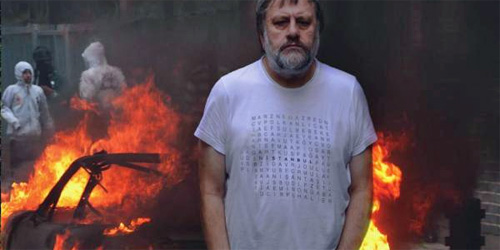
Zizek suavely evading flaming wreckage


In “The Year of Dreaming Dangerously”, Zizek attempts to analyze some of the most politically aware events of the 21st century, including HBO’s “The Wire” and the Occupy Wall St. movement. Both of these are reactions to (as my fellow blogger Boros put it) the brutality of the modern situation: the Occupy movement being a group of activists who recognize the inadequacy of democratic institutions, and The Wire being a harrowing portrayal of the perverse relationship between law enforcement and poor black people.  Since both The Wire and Occupy Wall St. are vital cultural phenomena, Zizek’s discussion of them manages to frame his critique of ideology in such a way that it becomes accessible to a layperson like me.
Zizek quotes David Simon, the creator of “The Wire”, as saying that “we pretend to engage in a war on narcotics, but in truth, we are simply brutalizing and dehumanizing an urban underclass that we no longer need as labor supply”. Given this harsh formulation, what are we to make of Simon’s humane and even positive portrayal of police officers (McNulty, Bunk, Lester Freamon etc.)? Somewhat paradoxically, since Simon has few illusions about the function of law enforcement in post-industrial urban areas, he is better able to render the goodness of the cops who are attempting to effect change within a pernicious institution. Zizek calls the acts of the “good cops” on The Wire utopian, but in an unconventional sense. Typically, a utopian action would seek to reform an institution or perfect a system; i.e. a utopic action is performed with the assumption that the “system” one is working within is perfectible. Plato’s Republic would be a classic example of this: it was an idealized version of the framework Plato was working under as an Athenian, and Plato advocated that people act with this ideal in mind. The world Simon presents in The Wire is one drowning in the arbitrary effects of corporate capitalism and neoliberal economic policies; he makes it clear that capitalism as a system, rather than people’s moral decrepitude, is at fault. The Wire has been frequently compared to Greek tragedy, but Zizek thinks that they differ in one important respect: Greek tragedy presents fatally flawed characters, The Wire presents characters living and working within a fatally flawed system. Of course, a term like “the system” is so vague that it barely means anything on its own; how does The Wire portray this flawed “system”? Zizek writes,
Here we encounter the formal limitation of The Wire: it has not solved the formal task of howto render, in a TV narrative, a universe in which abstraction reigns. The Wire’s limit is the limit of psychological realism…          
The Wire’s panoramic final scene shows a series of long shots of various locations around Baltimore. This reposeful cinematic gesture allows the viewer to process the fact that new generations of drug dealers, cops and corrupt politicians will come to replace the ones we loved or loved to hate. I will elaborate more on this in the next section, but in Zizek’s mind, one of the functions of ideology is to set up chains of equivalences- such as “people are poor because they use drugs”- when in reality, the urban  poor of Baltimore are poor because the economy has rendered them useless and they are offered little to no opportunities to transcend their situation. Their neighborhoods are flooded with drugs and terrorized both by the gangs who sell the drugs and by the police. The “System” can be apprehended through an understanding of the absurdity of the situations it creates, not as an immutable or transcendental entity in and of itself. With that in mind, I’ll now discuss the Occupy movement and Zizek’s view of the status of activism in general in the 2010’s.
           
I remember when the Occupy Wall Street movement first began. The summer after my freshman year of college I began getting the email blasts from Adbusters Magazine spreading the word about a planned occupation of Zuccotti Park, and once it was underway I avidly read every article I could find about it and watched videos of various people speaking at it (including Slavoj Zizek). I tried to soak up as much as the internet would allow. What made the Occupy Wall St. movement special? And why were most of the appraisals of it by the mainstream press so vacuous? Zizek uses his psychoanalytic training, and his readings of Lacan and Hegel, to attempt to answer those questions.
           
Zizek uses a quote from the journalist Anne Applebaum, who writes for the Washington Post, to exemplify the mainstream (ideologically-sanctioned) reaction to Occupy. She first claims that Occupy protestors (who, by the time she wrote this article, were all over the globe) are correct in their view that democratic institutions are not capable of dealing with the problems created by globalization; several paragraphs after that she chastises protestors for not using those institutions to reach their ends, and even goes on to state that Occupy and related protests will have the negative side effect of hastening the decline of existing democratic institutions. This argument is obviously fallacious, and as such nothing intelligible can be derived from it. Its unintelligibility sheds light on how ideology functions; Applebaum manages to appear reasonable by both expressing tentative praise and haughty ambivalence towards protest movements. She politely acknowledges the unsustainability of the “system” while simultaneously declaring recognition of the “system’s” unsustainability unrealistic.
           
If you’ve taken a course in logic, you know that once a contradiction has been established, anything can be asserted. Well, the liberal apologist view that I (via Zizek) debunked above results in a smug contradiction which opens a space for new ways of thinking about and understanding our situation. I offer the following formulation as a Zizekian philosophical maxim: “The more obvious a teleological explanation of an event is, the more crucial the speculative surrender of the self to the absolute becomes”.  What the fuck does this mean? Zizek here deploys French philosopher Jean-Pierre Dupuy’s term “zero-point”; i.e. the economic and environmental collapse that capitalism is tending towards. In the face of coming ecological and economic crises, a politically pessimistic outlook seems justified. Pessimism of this kind is ultimately teleological because it equates the collapse of the” system” with nothingness, with the apocalypse. Zizek has many times criticized liberals for being better able to imagine the end of the world than the end of capitalism; but isn’t this indeed how ideology functions? Pessimism about the future of capitalism is certainly called for, and the brutal truth that our lifetime is going to be spent during the slow, violent death of capitalism is a truly shitty fact to contend with. The brutality of this fact and the pessimistic outlook it inspires aren’t grounds for a fatalistic anti-capitalistic viewpoint, though. Each crisis ostensibly brought about by “capitalism” simultaneously erodes capitalism as a functioning system. This is where the “speculative surrender of the self to the absolute” comes in. Zizek writes, “The only way to sustain the Real when it gets too close-that is, the only way to avoid psychosis- is to fictionalize it”. Attempts to reform a failing, inherently dehumanizing system are literally absurd; the only way to engage with the Real of systemic collapse is by speculating about how limited and small you are; about how unintelligible the forces working on you are. This is what Occupy attempted to do: engage with reality in a world that demands disengagement and abject ignorance at any cost.

My first post dealt with novelist Don DeLillo. His book Cosmopolis centers around billionaire hedge-fund manager Eric Packer’s aimless limousine ride around New York City. At one point, Packer gets caught in the middle of a riot thrown by anarchists and communists. He dismisses the whole event as a “market factor”, and indeed, once the riot subsides, business-as-usual resumes. During the riot, however, a man sets himself on fire Tibetan monk style. Packer can’t account for the jarringness of this event. It functions as sign, or perhaps a symbol, of both the untenability of the present and the necessity of the future. It makes sense that the final chapter of Zizek’s book is called “Signs from the Future”. In this chapter, Zizek quotes Blaise Pascal: “There is enough light for those who only desire to see, and enough obscurity for those who have a contrary disposition”.  Strangely, if one hopes to cultivate a rational disposition with regards to political thinking, a theological perspective is useful. John Locke says that if the government won’t heed your pleas, your best bet is to appeal to heaven. As democratic institutions become more and more useless, it would benefit us, Zizek thinks, not to adopt a dark fatalism, but rather to look to the heavens and recognize our own contingency.

Sunday, July 15, 2012

The Spiral in Permanent Revolutions: Gurren Lagann via Gilles Deleuze

THE GENETIC DIVERSITY RESULTING FROM GAMOGENESIS IS THE KEY TO EVOLUTION. IT'S THAT THAT KEEPS SPIRAL POWER MOVING FORWARD.
- Leeron Littner

At first glance, Gurren Lagann looks like a generic example of Shonen anime.  Its story is hackeneyed: young man starts into the world from his small town and quickly gathers a group of eclectic friends to face down a global-level threat. As it follows this basic format it is easy to mistake Gurren Lagann for an earnest tribute to its forerunners, counting such classics as Getter Robo, Mobile Suit Gundam, and Gundam Wing and other exemplars of the "Real Robo" and ,"Super Robo" genres as its wikipedia-obvious influences.  You could see it falling well in line with its better known, longer running contemporaries like One Piece or Naruto. But Gurren Lagann transcends the limits of its genre-siblings and forerunners by pushing the conventions of Shonen to the edge of absurdity in a single season-length statement.  This manic, concise, and ultimately critical spirit makes Gurren Lagann one of the most interesting anime I have come across.

The show affects its aesthetic and narrative feats by finding spirals at the heart of the genre and bringing them to the forefront. Watching this theme develop on-screen, you're surprised that you hadn't thought about it when viewing Gurren Lagann's act-alikes (assuming you hadn't); Shonen repeats the cycle of get stronger, beat boss, discover new threat.  It shares this narrative structure with video games, particularly early generation RPGs that were severely limited in gameplay diversity by virtue of their hardware and thus were forced to repeat variations on a theme.  But limited structure can sometimes make for the most inspiring art, and Gurren Lagann achieves baroque-pop greatness by taking this repetition and expanding it in a profoundly exuberant way. Far from being fanboy gushy about its influences, this expansion is accompanied by a surprising self-awareness that allows the show a critical reflection that is all too often missing from its fellows. This reflective stance transforms Gurren Lagann into a meditation on desire.


Already in this trailer you can see that Gurren Lagann does not shy from an overt traditional masculinity and a certain teenage puerility.  This may turn some off from the show; it certainly made me more wary when I started watching it (especially since some scenes are explicitly transphobic).  I think the show can be legitimately criticized for its shortcomings, but I also think that it embraces its kinks as part of the territory; when you're going to create the ultimate Shonen, you have to be willing to express its weaknesses just as much as its strengths.  This willingness to capture the entirety of the genre, flaws intact, defines the progression of the show.  It is "orgasmically" structured; each "circle" in the "spiral" of its narrative structure follows the aforementioned build-up, climax, recovery cycle.  And what's interesting is that the characters suffer the consequences.

Note: This next section will make a hell of a lot more sense if you have seen the series.  If you have not, hopefully I have piqued your curiosity enough that you'll go try it, maybe watch it, and come back.

Take, for example, the transition between the first and second major arcs of the series. Simone acts as a subject orbiting around an object of desire in both, the object of the first arc being Kamina and his desire to "break through the heavens," his desire for freedom, and the second being Nia and her desire to discover her purpose.  When Team Gurren has a center, it becomes what Deleuze calls "fascicular"; it spirals outward and echoes the power of its origin in an expansive and exploratory way.  For example, Team Gurren's escape through the ceiling of the hometown, the destruction of the four spiral generals, and the acquisition of Dai-Gurren act as echoes of Kamina's willingness to "drill" through the established order through sheer will in the first arc act as good examples of this echoing.  The more important note here is that in the interstitial period, when Team Gurren has no definite focal point, it flops.  Simone's depression and the establishment of the well-intentioned totalitarian world state after the second arc leap immediately to mind here.  It's easy to argue that the third and final act of the series is about Simone finding and expressing his conjugal desire for Nia.  But there are two interesting weaknesses to this third desiring relationship that beautifully illustrate the question that animates the series.

The first is that Simone's desire for Nia isn't strong enough.  When the Anti-Spiral traps Team Gurren in the alternate dimensions where they act as other selves, they stay stuck there.  It takes Kamina's reappearance and reactivation of Team Gurren's old desire, that is to say Kamina's desire, for freedom to jar them back into the fight. Trapped by their otherwise mediocre and everyday desires, they rely on Kamina's strength to galvanize them to their utmost potential.  Kamina here becomes more than an "individual" or a "symbol"; in this sequence, Kamina is a becoming.  Characters that are becoming-Kamina are each transformed in entirely different ways, each striving to reach their utmost expression.  Nowhere is this better captured than when Kamina explains that when he doesn't believe in himself, he relies on the him that Simone believes in, the becoming-Kamina in himself that defies his insecurities and transforms him into an expression rather than an individual.  This is further validated by the scene where Simone tells Kamina he'll "always be in his heart" and goes on to destroy the Anti-Spiral; Kamina has ceased being a person or a symbol, and become a freeing affect.

The second weakness of the central relationship of the third act is that after this final desire is consummated in the symbolic marriage of Simone and Nia, both characters are finished and the series is over.  It's easy to forget that Gurren Lagann ends on a cliffhanging, bittersweet note; the bulk of the characters take up becoming-Kamina again and presumably go on to challenge the spiral nemesis, but Simone ends up tired and comically impotent (skip to 21:56, unless you want to see the whole final episode and/or hear the Four Year Strong-esque end theme):


This is what I find truly fascinating about Gurren Lagann; every productive and strong force in the entire show relies on the drive to freedom of becoming-Kamina.  To me, becoming-Kamina is a perfect example of Deleuze's successful war-machine, the nomadic flow that continually escapes established boundaries on its own novel flight path.  When becoming-Kamina, Team Gurren creates, steals, and destroys with an anarchist glee; when forced to become sedentary, they lapse into a sometimes dangerous or aimless segmentation. The stand-out reference for this "reterritorialization" is Rossiu's world-state.  The series takes pains to make it explicit that his carefully planned order is born of his original religious resentment and is parasitic on the raw desire unlocked by Kamina; he tries to control, quantify it, and reduce it to its utility, but cannot fully contain its flow (as a perfect example, consider the Grapearls; mass produced based on Gurren Lagann's technology, they ultimately cannot come close to matching it).  Eventually the war-machine starts up again and the state relinquishes control when the Anti-Spirals shatter Rossiu's carefully constructed equilibrium.  Kamina and Team Gurren are a line of flight that breaks free from centered structures, including the identities of Kamina and Simone themselves.

Team Gurren is stuck vacillating between their self-sustaining collective desire and their centered, serial dependence on their cycle of become stronger, win the battle, and suffer refraction.  This assemblage is the basis of the startlingly interesting dynamic exploration that makes Gurren Lagann worth watching and worth thinking about.  At times, Team Gurren use their alliance and shared desire to act as a multitude straight out of Hardt and Negri's Empire.  At others, they fall into the "black hole" of hierarchy and complacency.  Their task (and perhaps ours) is either to find a practice of desiring that doesn't rely on a constantly collapsing structure of desired objects, but instead puts emphasis on sustained "plateaued" force (Trotsky, Deleuze/Guattari) or accept that the tragic structure is our lot and heroically embrace this fate (Camus, Zizek).  Or, to put it in appropriately melodramatic terms, are we up in the sky with Kamina, or stuck on the ground with Simone?